Backyard Office Studio Ideas Built for Focus and Function
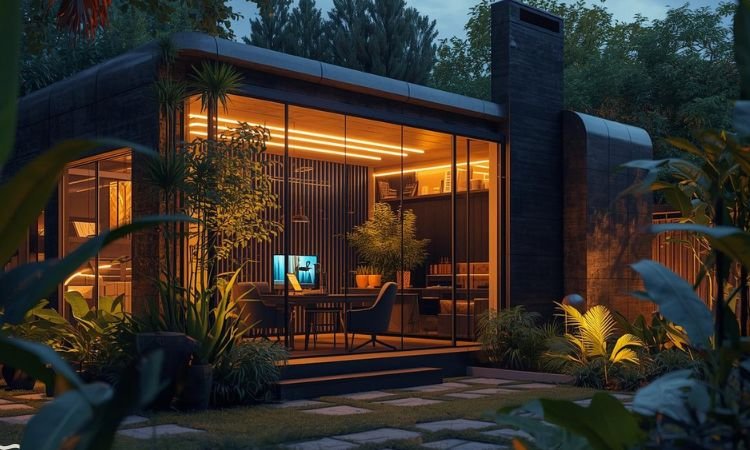
A backyard office studio doesn’t need to be large to work well.
Most effective setups fit within 120 to 200 sq ft—enough room for a desk, chair, small storage, and walking space—while staying under typical permit thresholds (often 200 sq ft or less in many U.S. municipalities).
These 10 ideas focus on real-world use: managing heat in summer, staying warm in winter, ensuring reliable power, and creating a quiet zone that supports deep work—all without custom architecture or six-figure budgets.
Why Compact Studios Work
Separation = concentration: Being 20–50 feet from the house reduces household noise and visual distractions.
Standard dimensions are sufficient: A 10’x12′ (120 sq ft) footprint fits a 60″ desk, ergonomic chair, two shelves, and 36″ of circulation space.
No plumbing needed: Skip sinks and toilets to avoid costly permits and utility runs.
Natural light improves focus: One or two properly placed windows cut reliance on artificial lighting during daytime hours.
10 Backyard Office Studio Ideas Built for Focus and Function
All concepts assume a freestanding structure with basic framing, roof, and door—no interior walls.
1. Central Desk with Perimeter Storage
Place your desk in the center of the room, facing a window. Run shallow shelves (12″ deep) along the remaining walls for books, files, and supplies. This layout uses the full footprint efficiently while keeping the workspace open.
In a 10’x12′ studio, this leaves a 36″-wide walkway around all sides—enough for movement without crowding.
2. Dual-Pane Windows for Insulation
Install at least one double-glazed vinyl window (e.g., 36″x36″) on the north or east wall to reduce heat gain and improve thermal performance. Dual-pane units have a U-factor of ~0.27 vs. 1.0+ for single glass—cutting heat loss by over 70%.
Position the window at seated eye level (42″ from floor) to maximize daylight without glare on screens.
3. Mini-Split HVAC System
Mount a 9,000 BTU ductless mini-split (indoor unit + outdoor compressor) for year-round climate control. It heats and cools 200–300 sq ft efficiently and runs on a standard 240V circuit.
The indoor unit mounts high on the wall (7–8 ft), freeing up floor and desk space. Installation costs $2,000–$3,500 but eliminates reliance on space heaters or window units.
4. Raised Floor Platform with Insulation
Build a 2″x6″ joist subfloor over a gravel base, fill with rigid foam (R-10), and top with plywood. Elevate the floor 6″ above grade to prevent moisture wicking and allow under-floor conduit for power or data.
This also creates a level surface even on slightly sloped ground. Total height stays under 8″ to avoid needing steps or railings.
5. Dedicated 20-Amp Electrical Circuit
Run a 12/2 underground feeder cable (UF-B) in PVC conduit (18″ deep) from your main panel to a small subpanel in the studio. Include at least four outlets, two overhead lights, and a dedicated circuit for electronics.
A 20-amp circuit supports a computer, monitor, lamp, mini-fridge, and heater—without tripping breakers.
6. Acoustic Panel Wall Treatment
Cover one wall (or ceiling) with 2″ thick acoustic panels (24″x48″) to reduce echo and outside noise. Place them opposite the door or near the desk for best effect.
In a 120 sq ft room, four panels (covering ~32 sq ft) noticeably improve sound clarity—critical for calls or recording.
7. Sliding Wall-Mounted Desk
Install a wall-mounted desk (48″–60″ wide) with folding legs or gas-lift support. When not in use, it folds flat against the wall, freeing the floor for yoga, guest seating, or storage bins.
Requires mounting into wall studs (16″ o.c.). Supports up to 75 lbs—enough for monitors and peripherals.
8. Exterior Equipment Enclosure
Build a small weatherproof box (24″x18″x12″) on the studio’s exterior wall to house the mini-split condenser, Wi-Fi router, or battery backup. Keeps noise and clutter outside while protecting gear from rain.
Mount it on the shaded side of the building. Use louvered vents for airflow and lockable doors for security.
9. Roof Overhang for Shade
Extend the roof 18–24 inches beyond the walls on the south and west sides. This blocks high summer sun while allowing low winter light to enter—passive temperature control with no energy cost.
Pair with deciduous vines on a trellis for added seasonal shading without blocking views.
10. Hardwired Ethernet Conduit
Bury ½” PVC conduit (18″ deep) from your house to the studio during construction. Pull Cat 6 cable later for gigabit internet—more reliable than Wi-Fi over distance.
Include a pull string inside the conduit for future upgrades. A direct wired connection ensures stable video calls and cloud access.
Common Oversights and Practical Fixes
No ventilation in winter
Fix: Install a small energy recovery ventilator (ERV) or operable louver near the ceiling to exchange air without losing heat.
Glare on screens
Fix: Use blackout roller shades on south/west windows. Keep them partially lowered during peak sun hours.
Ignoring door placement
Fix: Position the door on the north or east side to avoid direct sun hitting the entrance—and your chair—during work hours.
Skipping grounding
Fix: Drive a ground rod at the studio and bond it to the subpanel. Protects electronics from surges, especially in detached structures.
Final Thought
A backyard office studio succeeds when it solves one core problem: giving you a quiet, climate-controlled space to work without distractions.
You don’t need luxury finishes—just solid insulation, reliable power, good lighting, and a layout that fits your daily routine.
Start with structure and climate, then add tech and comfort. Even a 10’x10′ space can become your most productive room.