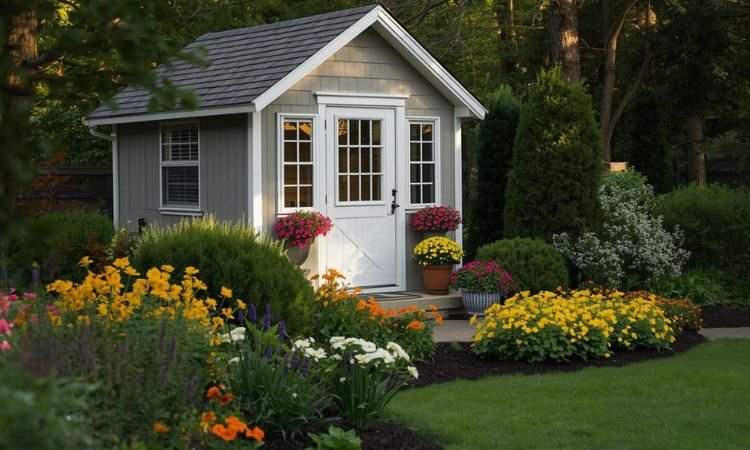
11 Backyard Workshop Ideas Built for Real Projects and Limited Space

A backyard workshop doesn’t need to be large to be effective.
Most functional setups fit within 100 to 200 sq ft—enough room for a workbench, tool storage, and safe movement—while staying under common permit limits (often 200 sq ft or less in many U.S. areas).
This guide covers 11 practical workshop ideas, including layout strategies, lighting solutions, power setups, and storage systems that work in standard shed dimensions like 8’x12′ or 10’x16′.
Every suggestion prioritizes safety, accessibility, and daily usability over aesthetics.
Why Compact Workshops Work
Separation from home noise and dust: Keeps sawdust, fumes, and noise out of living spaces.
Standard shed sizes are sufficient: An 8’x12′ (96 sq ft) footprint fits a 6′ workbench, two wall storage units, and 36″ of walking space on three sides.
No plumbing required: Avoid sinks and water lines to skip costly permits and utility runs.
Natural light improves precision: One well-placed window reduces reliance on artificial lighting during daytime tasks.
11 Backyard Workshop Ideas Built for Real Projects and Limited Space
All concepts assume a basic wood-frame structure with a single door, concrete or gravel floor, and minimal electrical.
1. Perimeter Workbench Layout
Run a continuous workbench along three walls, leaving the center open for movement. Standard bench depth: 24″–30″; height: 34″–36″. This maximizes surface area while preserving a 36″-wide central aisle.
In a 10’x12′ shed, this layout provides over 18 linear feet of workspace—enough for cutting, assembly, and clamping.
2. Pegboard Wall System (4’x8′ Minimum)
Mount industrial-grade pegboard on at least one full wall. Use labeled hooks, bins, and bars to hold hand tools, clamps, and measuring tapes. Keep frequently used items at waist to eye level (30″–60″).
Standard pegboard panels are 4’x8’—one covers a full wall section. Paint matte white for visibility and easy cleaning.
3. Overhead Storage Racks
Install ceiling-mounted racks (rated for 150+ lbs) to store long lumber, sheet goods, or seasonal items. Mount 18″–24″ below ceiling to allow head clearance while maximizing vertical space.
Use in sheds with 8’+ ceilings. Keep stored items lightweight or evenly distributed to avoid structural stress.
4. Dedicated 20-Amp Circuit with GFCI
Run a 12/2 UF-B cable in PVC conduit (18″ deep) from your main panel to a small subpanel in the workshop. Include at least six outlets, two overhead lights, and a dedicated circuit for power tools.
A 20-amp circuit safely powers a table saw, drill press, or air compressor without tripping—critical for consistent workflow.
5. Dual Task Lighting Zones
Combine LED shop lights (4,000K, 5,000+ lumens) for general illumination with adjustable swing-arm lamps (3,000K) at the workbench. General lighting covers the whole space; task lighting eliminates shadows on cuts.
Mount shop lights every 6′ along the ceiling. Use plug-in or hardwired task lamps based on outlet access.
6. Mobile Tool Cart (24″x18″ Base)
Build or buy a rolling cart with drawers and a top tray. Store chisels, bits, sandpaper, and fasteners here. Lock casters when parked. Fits in leftover corners or under overhangs.
Keep cart width under 24″ so it doesn’t block aisles. Two drawers + one open tray is enough for most hand tools.
7. Sliding Barn Door for Equipment
Install a 36″-wide sliding barn door over a shallow closet or shelving unit to hide power cords, extension reels, or safety gear. Saves the 24″ of swing space a hinged door needs.
Use heavy-duty track hardware (rated 200+ lbs). Ideal for narrow workshops where every inch counts.
8. Ventilation Louvers Opposite Door
Cut a 12″x12″ opening high on the wall opposite the entry and install passive louver vents. Creates cross-ventilation to remove sawdust and fumes—no electricity needed.
Pair with a small box fan on the door side to pull air through. Reduces airborne particles by up to 60% during sanding.
9. Fold-Down Cutting Table
Mount a wall-supported drop-leaf table (48″ W x 24″ D) that folds flat when not in use. Use for measuring, gluing, or small assemblies. Supports up to 75 lbs when open.
Mount brackets into wall studs (16″ o.c.). Gas springs or folding legs ensure smooth operation. Frees floor space for larger projects.
10. Fireproof Storage for Flammables
Store paint, solvents, or propane in a UL-listed flammable cabinet (typically 24″W x 18″D x 36″H). Keep it away from heat sources and direct sun. Required by code in many areas for quantities over 5 gallons.
Place near the door for quick access in emergencies. Never store on open shelves or in plastic bins.
11. Gravel Floor with Drainage Slope
Lay ¾” crushed gravel over landscape fabric, sloped ¼” per foot toward the door. Allows water runoff, reduces mud, and provides stable footing. Cheaper and more durable than concrete for light-use workshops.
Add perimeter edging to contain gravel. Top with rubber mats at the workbench for comfort during long sessions.
Common Oversights and Practical Fixes
No dust collection plan
Fix: Use a shop vacuum with a HEPA filter for sanding. Even basic models reduce airborne particles significantly.
Poor door placement
Fix: Position the door on the long wall, not the short end—makes it easier to move large materials in and out.
Ignoring fire safety
Fix: Mount a 5-lb ABC fire extinguisher near the door. Check pressure monthly.
Skipping grounding
Fix: Drive a ground rod at the workshop and bond it to the subpanel. Protects tools and users from surges.
Wrap It Up With Purpose, Not Perfection
A great backyard workshop isn’t about having every tool—it’s about having a safe, organized space where you can actually use the ones you own. Start with solid lighting, reliable power, and smart storage. Add comfort later.
Which of these 11 ideas fits your shed’s size and your project list? Measure first—most work in spaces as small as 8’x10′.