Narrow Balcony Ideas That Make the Most of Tight, Linear Spaces
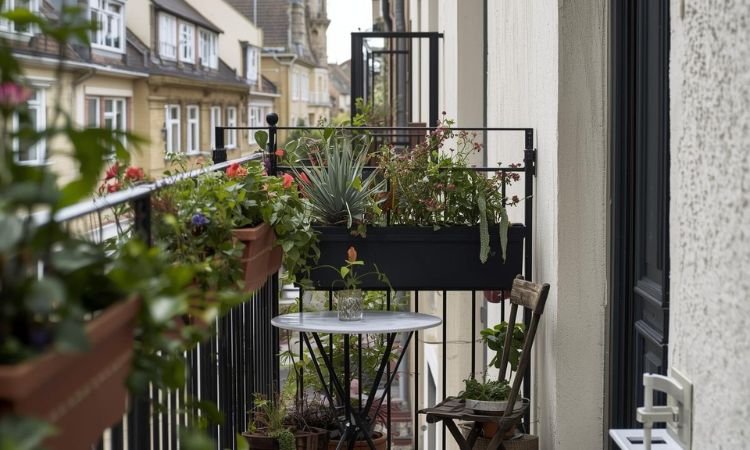
Narrow balconies—often just 3′ to 4′ wide but 8′ to 12′ long—present a unique challenge: how to add comfort without blocking movement.
These linear spaces are common in urban apartments and row houses, where every inch counts. The main part is working with the length, not against it, by using low-profile furniture, vertical storage, and strategic zoning to create function without clutter.
Forget trying to fit a full dining set or deep seating. Instead, focus on one clear purpose: a morning coffee spot, an evening reading nook, or a vertical garden. These 11 ideas prioritize airflow, weight limits, and ease of use so your narrow balcony feels open, not stuffed.
Why Narrow Balconies Need a Different Approach
Clear walkway is essential: Keep at least 24″ of open floor for safe passage from door to railing.
Furniture must be shallow: Choose pieces under 18″ deep to avoid crowding.
Vertical space is free real estate: Walls and railings can hold plants, lighting, and storage.
Weight adds up fast: Most balconies support only 50–100 lbs per sq ft—including people and pots.
11 Narrow Balcony Ideas That Make the Most of Tight, Linear Spaces
All concepts work in balconies as narrow as 3 feet wide and assume standard railing height (36″–42″).
1. Single Bench Along One Wall
Install a built-in or freestanding bench (16″–18″ deep) along the longest wall, leaving the opposite side fully open for walking.
Use rot-resistant wood or all-weather composite, and add a removable cushion only when in use to prevent mildew in humid conditions.
2. Wall-Mounted Drop-Down Table
Mount a hinged table (24″x18″) on one wall that folds flat when not in use, paired with a single stool or floor cushion.
This creates a functional spot for coffee or laptop work without permanently occupying floor space in the narrow footprint.
3. Vertical Garden on Railing and Wall
Attach narrow trough planters to the railing and mount pocket planters or slim shelves on the wall to grow herbs, ferns, or trailing vines.
Keep all planters under 8″ deep to avoid encroaching on the walkway, and use self-watering systems to reduce maintenance.
4. Slim Rolling Cart for Flexible Use
Place a narrow utility cart (16″ W x 12″ D) on lockable casters to hold drinks, plants, or a small speaker near the railing.
Roll it aside for cleaning or entertaining, and store it against the wall when not in use to keep the center path clear.
5. Hanging Chair at One End
Suspend a compact hanging chair from a ceiling beam at the far end of the balcony to add seating without floor footprint.
Choose weather-resistant materials and ensure hardware is rated for dynamic loads of at least 250 lbs for safety and stability.
6. Floor-to-Ceiling Curtains for Privacy
Hang outdoor-rated curtains from a ceiling-mounted track along the open side to block neighbor views or wind while preserving floor space.
Use lightweight, mildew-resistant fabric in neutral tones like oat or charcoal to avoid visual heaviness in the tight space.
7. Linear Outdoor Rug (3’x8′)
Lay a narrow flat-weave polypropylene rug (3’x8′) to define the walking path and add comfort underfoot without overwhelming the width.
Choose fade-resistant material in soft gray, oat, or olive to unify the space and reduce visual clutter in tight sightlines.
8. Wall-Mounted Sconces or String Lights
Install two wall-mounted LED sconces or run warm-white string lights along the top of one wall for ambient evening lighting.
Avoid floor or table lamps—they take up precious surface area and create tripping hazards in narrow passages.
9. Foldable Stool or Floor Cushion Storage
Store a single folding stool or two floor cushions in a lidded bin under the bench or against the wall for occasional seating.
Pull them out only when needed, then tuck them away to maintain clear circulation during daily use or cleaning.
10. Full-Length Mirror on Side Wall
Mount a frameless mirror (24″x60″) on one side wall to reflect light and double the sense of width in the narrow space.
Position it opposite a window or light source to maximize brightness and make the balcony feel less confined.
11. Monochromatic Color Palette for Calm
Limit visible colors to two: e.g., black + cream, oak + gray, or navy + white, applied to furniture, textiles, and plant pots.
This reduces visual noise in tight sightlines and makes the linear space feel intentional, not chaotic or cluttered.
Common Mistakes and Fixes
- Blocking the walkway
Fix: Always keep 24″ of clear floor space from door to railing—measure before buying furniture. - Using deep furniture
Fix: Choose pieces under 18″ deep. Standard chairs (20″+) will crowd a 3’–4′ wide balcony. - Ignoring door swing
Fix: Ensure furniture doesn’t block the door when it opens—test with tape on the floor first. - Overloading with decor
Fix: Skip rugs wider than 3′, large planters, or multiple seating pieces. Less is more. - Skipping weight checks
Fix: Add up people + furniture + wet soil. Stay under 75% of your balcony’s load limit for safety.
Work With the Line, Not Against It
A narrow balcony isn’t a limitation—it’s a design opportunity. By embracing its linear shape and prioritizing flow over furniture, you can create a space that feels calm, functional, and uniquely yours.
Have you transformed a narrow balcony? Did you go for a wall-mounted table, vertical garden, or single bench?
Share your setup in the comments—we’d love to hear how you’ve made every inch count in your slim outdoor space.